Envisioning Tomorrow's Code
EY Tower · Berlin Mitte · 16 May 2024
Hasso-Plattner-Institut · EY · MaibornWolff · Seerene · German Deep Tech Group




The Hasso Plattner Institute, EY, MaibornWolff, Seerene, and the German Deep Tech Group invited some of the leading software executives and academics to the EY tower in Berlin Mitte for a day of open dialogue and strategy.
Talks & Discussions
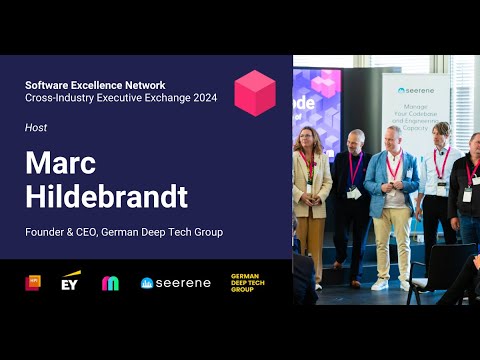
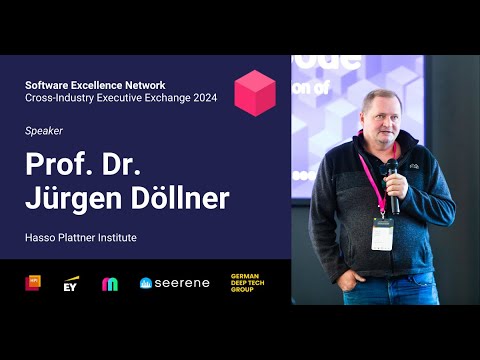
Prof. Dr. Jürgen Döllner opens the event with a fundamental assessment of AI in software engineering. He argues that generative AI will change nearly every aspect of software development within a decade, and that organizations which do not adapt risk disruption.
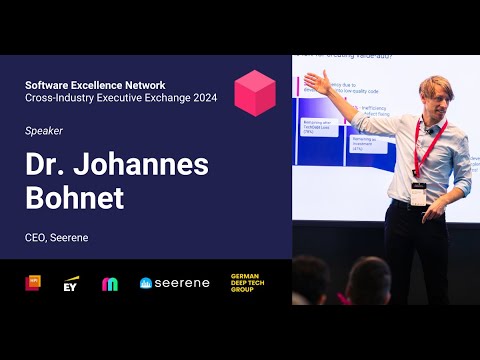
Dr. Johannes Bohnet examines the opportunities and risks of generative AI in industrial software production. Studies show developers with AI tools produce up to three times more code per week, but defect rates rise by a factor of 1.5 without adequate testing infrastructure. Bohnet makes the case for governance systems that make productivity gains measurable while scaling quality assurance in parallel.
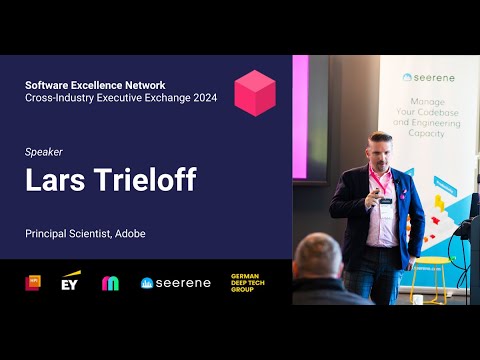
Lars Trieloff traces Adobe's 30-year journey from on-premise to SaaS, showing how software organizations must continuously reinvent themselves. He introduces concepts like Gall's Law and an "Innovation Budget" that gives teams control over the complexity they introduce. The latest SaaS generation achieved sharply reduced time-to-market and significantly lower operating costs.
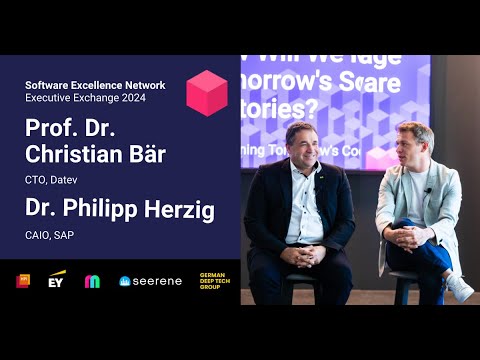
Dr. Philipp Herzig and Prof. Dr. Christian Bär discuss how AI-generated codebases are shifting the role of experienced developers. Herzig describes how senior engineers can focus more on architecture and quality governance as AI handles routine coding tasks. The panel addresses accountability structures in increasingly automated software organizations.

Sally Trivino addresses the ethical and organizational responsibilities that come with scaling AI in software development. The talk covers how companies can grow AI capabilities without losing control, quality, or human oversight. Trivino connects the technology perspective with regulatory and cultural requirements for executive leaders.
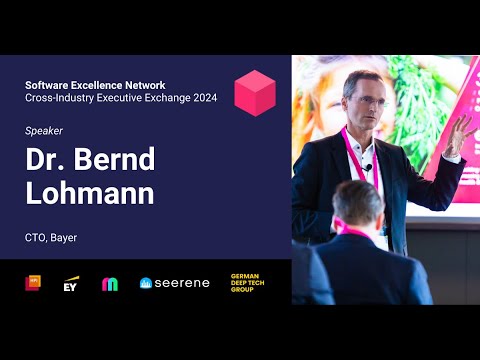
Dr. Bernd Lohmann describes the software portfolio of a global life sciences company: over 6,000 applications, 80 percent of them legacy systems running alongside modern AI and agile initiatives. He introduces the "Dynamic Shared Ownership" operating model, which reduces bureaucracy and strengthens local accountability at scale. The talk shows how an organization of this size manages the balance between system maintenance and continuous innovation.
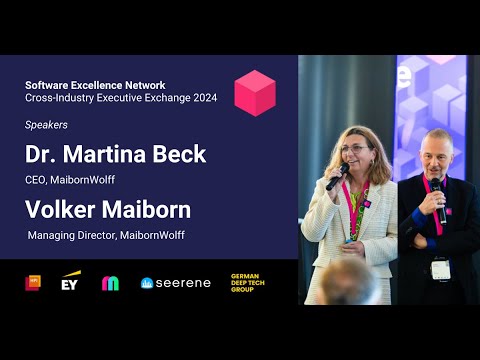
Volker Maiborn and Dr. Martina Beck close the day with an overview of five digitalization trends shaping enterprises: Generative AI, Cloud Computing, Green IT, Talent Management, and Digital Design. Maiborn presents a BMW migration project where GenAI enabled a fivefold productivity increase at 70 percent cost reduction. Beck positions Digital Design as a discipline in its own right, asking not just how software is built but what should be built.
Speakers & panelists


From the event


