How it works
From a 30-minute Executive Briefing to your first management review.
The engagement is designed around one decision you need to take. Everything else follows from it: the sources we connect, the success criterion, the people involved and the review at the end. The read-only connection covers the perimeter agreed in scoping — several production lines that differ in technology and method, up to your whole software production, never a single team. What is scoped is the question.
Read-only, no change to tools or workflowsTypically 8–16 net working hours for one technical contactEngineering validates before leadership decides

The path
Five steps, one management question
One management question guides the engagement. The read-only connection covers the whole production system of an agreed perimeter — several production lines, never a single team; the five steps make the people, prerequisites and outcome clear.
-
01Executive BriefingSponsor and Seerene leadership · about 30 minutes
Clarify the relevant management question and the expected insight.
OutcomeWritten summary for internal forwarding. -
02Technical validation callYour engineering lead and Seerene engineering
Review data sources, access, coverage and prerequisites with one technical contact.
OutcomeDocumented scope of read-only access per source. -
03Scoping with the sponsorSponsor, engineering lead, Seerene
Confirm the decision question, success criterion and specific proposal. Plan security review, procurement and works council alignment in parallel, using the documentation Seerene provides.
OutcomeConfirmed question and success criterion; specific proposal. -
04Independent baselineTechnical contact, engineering leads, Seerene · typically about 30 days from data readiness
Connect the agreed perimeter, read-only metadata, and validate the findings with engineering.
OutcomeBaseline findings validated with engineering. -
05Management reviewSponsor, segment heads, Seerene
Review findings, evidence and options against the management question.
OutcomeActions with owners and a date for the impact review.
The independent baseline in practice
Scope, roles, data and day-30 results
Agree the scope, roles and timing in scoping. The baseline connects the whole production system of the agreed perimeter — product lines, sites and partners as one system, not isolated pilots. One agreed management question focuses the first review.
Before the baseline
Before data readiness
Weeks 0–4 · indicative
Scope and clearance
Who
Security, procurement, works council and technical contact
Agree the management question and perimeter. Review read-only access with IT security, inform the works council on system-level analysis without individual data, and validate connectors, including legacy SCM and ALM.
Outcome
Agreed scope and access prerequisites.
Data readiness · baseline clock starts
The baseline
~30 days
From data readiness
Baseline
Who
One technical contact · typically 8–16 net working hours in total; engineering leads validate the findings.
Connect metadata and map repositories to product lines, sites and partners. Review the first capacity mix, hotspots and flow with engineering leads.
Outcome
Engineering-validated findings for the management question.
Day 30
From data readiness · indicative
Management review
Who
Sponsor, segment heads, Seerene
Review the findings and evidence against the management question, with 3–5 proposed priority actions and owners. Agree the next step.
Outcome
Priority actions, owners and next step.
After the baseline · indicative review rhythm
Day 60
From data readiness · indicative
Decisions
Who
Leadership and engineering
Plan prioritized interventions with owners and assess where capacity could be redirected.
Outcome
An agreed intervention plan; capacity effects remain to be reviewed.
Day 90
From data readiness · indicative
Rhythm
Who
Weekly · cadence agreed with the sponsor · quarterly
Plan the review cadence and schedule the first impact review. Give each decision a date to check the same evidence again.
Outcome
Review cadence and a scheduled impact review.
Timing is indicative. All day markers count from data readiness; the baseline typically takes about 30 days from that point. Clearance time depends on IT security and co-determination processes. Day 30 is an evidence review, not a contractual exit, and ends with a decision to continue, expand or stop. Four short leadership touchpoints structure the first 90 days — scoping, the day-30 review and the first two executive pulses — an example at a monthly cadence; the actual review dates are agreed in scoping. They are the condition for the effect, not an option: the technical work can be delegated, the decision cannot.
What you see on day 30 · the Digital Boardroom
One view per management level, built from your own production lines
The baseline ends with these views on your data: C-level, top and mid-level management read the same information space, each at its own altitude. Select a level: the pyramid highlights it and the matching Digital Boardroom views appear.
X-Axis · Development flow · Y-Axis · Production lines · Z-Axis · Management levels. The selected management level is lit in the pyramid; the paths show how the evidence beneath it is built.
CXO, CTO, CIO
Where does our capacity go, and where does AI pay off end-to-end?
Portfolio priorities: the capacity mix per production line.
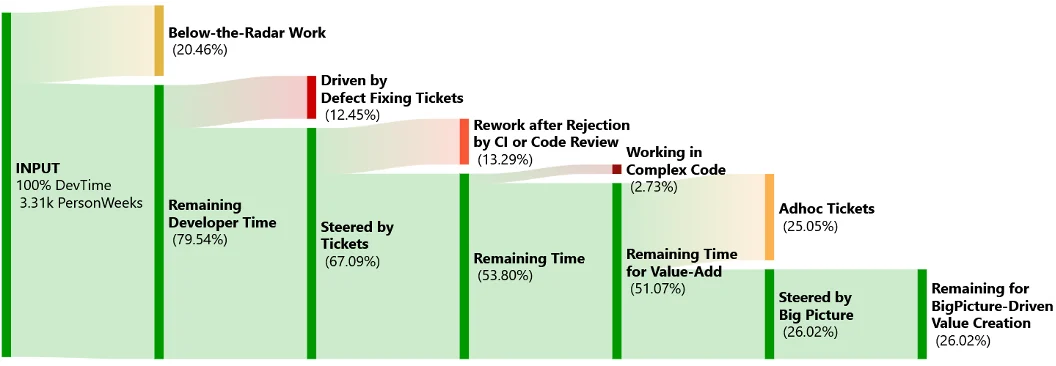
Capacity flow by production line · Digital Boardroom view, native rendition of the demonstration dataset · percentages as in the product view · open to enlarge
No individual monitoring: systems and teams are measured, never individuals. Read-only by design: source code stays in place.
Who provides what
Your side, our side
Role
Executive sponsor
What you provide
One decision to take, and the mandate for a baseline scoped to it.
What you get
A portfolio-wide, independent view and a documented decision with owners and a review date.
Role
Engineering lead
What you provide
One validation call, and a review of the findings that concern your systems.
What you get
Causes priced in capacity and risk, in the language leadership uses, validated by you before anyone decides.
Role
Technical point person
What you provide
Typically 8–16 net working hours in total for the read-only connection, a typical value, not per source system; confirmed in technical validation.
What you get
A documented scope of access per source and a connection that can be removed without residue.
Role
Security, procurement, works council
What you provide
Review time planned in parallel.
What you get
Documentation of architecture, access scope and team-level aggregation for each review.
After the baseline
A light review rhythm turns evidence into accountable action
Management by exception: a few short touchpoints, aligned with the sponsor’s management cadence; oversight, not being briefed. The executive pulse is the executive’s part of the product; preparation and engineering follow-up sit outside these reviews.
Weekly · 15 minutes · operational exception review
Exception review by responsible leads: KPI trend, outliers across units, systems and partners, root-cause evidence, corrective action with owners.
Executive Pulse · 15 minutes per review
The executive’s vote: CXO and direct reports read one verified view and take three decisions — where are we off track, who acts next, what changes before the next review?
Aligned with your management cadence — weekly, every two weeks or monthly.
First four to six rounds · guided
Seerene joins the governance round while the first deviations are explained. Every deviation gets the team’s explanation before it is decided (context register); every round ends with a decision record: question, finding, context, decision, owner, next review.
Quarterly
Condensed view for board and supervisory functions: investment effect and material risks over time; oversight, clearly separated from operational steering.
Continuous view
The model is maintained from the connected sources. Figures do not go stale between reviews, and no one assembles slides by hand.
No lock-in
The connection is read-only and can be terminated. Contractual terms for data handling at termination are documented in the offer.