Across large enterprises, a stubborn share of software investment fails to translate into business value. In many organizations, less than 40% of developer time and budget produces outcomes customers or the business care about; the rest is lost to rework, defect-fixing, below-the-radar activities, and unmanaged complexity.
Evidence from large corporate settings suggests that a realistic baseline inefficiency can approach 60% of software spend, with seven- and eight-figure annual consequences for any firm employing thousands of developers.
Why Software Efficiency Now Demands Board-Level Attention
Software has been "industrial" for a long time, but executive management practices have lagged behind. Most C-suites can recite cycle times and scrap rates for physical plants; far fewer can point to a single, trusted efficiency metric for the software factory.
An executive-caliber transparency layer does three things:
- It translates technical realities into financial and operational terms that leaders can act on—time and money.
- It exposes where value "leaks": avoidable defects, quality debt, and unsteered work.
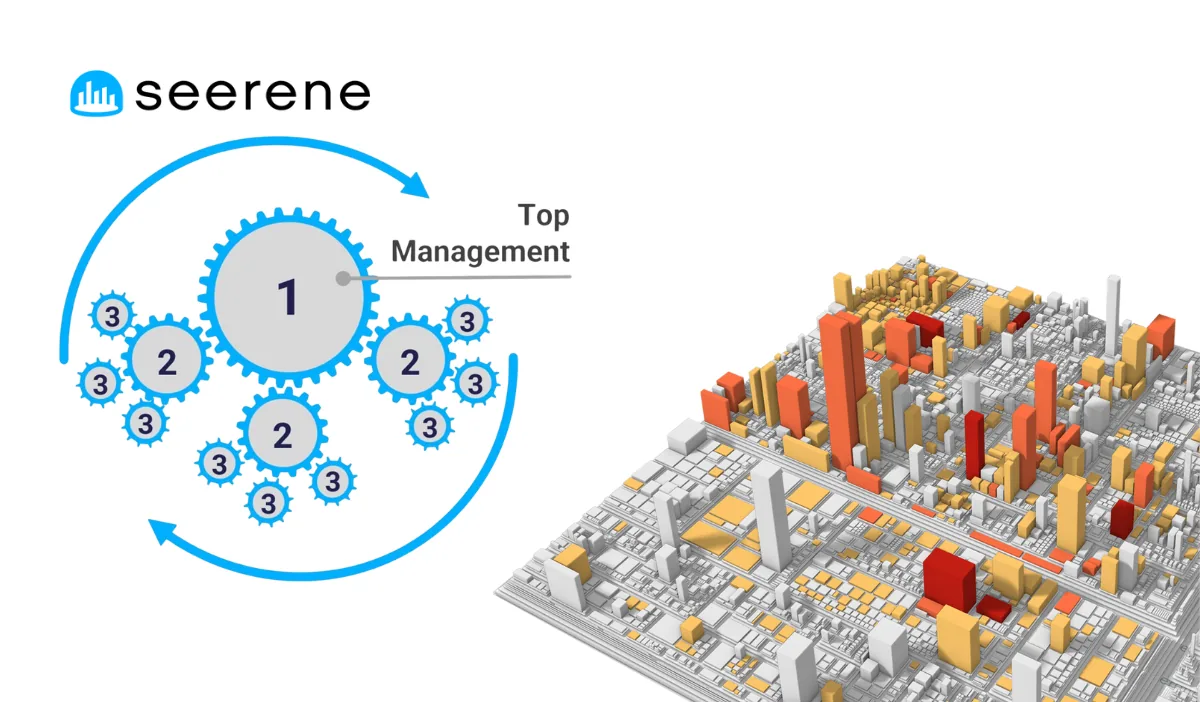
- It sets off a "clockwork" cascade of continuous improvement, because the same metric is visible and trusted at every level, from code hotspots to the boardroom.
The Empirical Picture: Where the 60% Goes
Consider a representative enterprise with ~1,000 developers and an annual software budget of ~€82.5 million. Using conservative assumptions (150 coding days per developer; €550 all-in cost per FTE day), analyses often surface roughly 60% inefficiency—on the order of 109,500 developer days and ~€60 million per year.
The loss is not monolithic: about a third typically sits in defect-fixing, a quarter in low-quality code that slows future work, and the remainder in unsteered activities that never align to business outcomes. Meanwhile, only ~€22 million of the annual spend flows into true "business topics."
Why Transparency Consistently Yields >25% Efficiency Gains
When a shared, outcome-anchored efficiency metric becomes the "operating language" of the software organization, three reinforcing dynamics appear:
1. Governance without bureaucracy. A single, comparable set of measures across heterogeneous toolchains and units replaces slide-based status rituals. The mere act of measurement and visibility has a focusing effect; teams align toward the same targets, and local improvements roll up to portfolio outcomes.
2. Kaizen for the digital enterprise. The evolution from shop-floor circles to fully digital, always-on improvement loops makes continuous improvement self-propelling. Teams can view inefficiency in units of time and budget, see hotspots in architecture, and choose the next best move with minimal arbitration.
3. Compounding returns. Typical trajectories show cumulative improvements in the high-teens to twenties in year one, with continued compounding in years two and three as structural quality debt is retired and unsteered work is squeezed out.
The Executive Operating Model: Minutes, Not Meetings
A frequent objection from senior leaders is that they cannot absorb another governance forum. The good news is they do not need to. In mature deployments, the CIO's monthly time investment can be measured in minutes, not hours.
What matters is a persistent, drill-down-capable view that ties portfolio-level efficiency to code-level causality. Two design choices make this minimal-time model work:
- Top-down comparability. The metric is uniform across divisions and products, enabling leaders to identify where capacity is best spent.
- Bottom-up explainability. Every executive roll-up is traceable to artifacts engineers trust. When a portfolio trend line shifts, responsible teams can point to specific architectural hotspots or process patterns.
Implementing an Executive System of Record for Software
Large enterprises often fear multi-quarter change programs. That is unnecessary here. Because the raw materials already exist in your development toolchain, the executive view can typically be switched on with very light touch: single-digit hours of technical effort to establish secure connectors to repositories and CI/build systems.
A pragmatic path:
Phase 1: Establish the baseline. Connect a representative slice of products; quantify current leakage in days and euros; validate with engineering and finance.
Phase 2: Institutionalize the cadence. Define a single executive page that answers three questions: Where are we today? What moved since last month? What is the next best intervention?
Phase 3: Scale and standardize. Expand to critical portfolios and suppliers, codify thresholds and triggers, and integrate the metric into investment cases, risk reviews, and quarterly business reviews.
What Leaders Should Measure (and Why It Works)
The most effective executive measures are disarmingly simple: time and money. Beneath that top line, the system traces inefficiency to the few causes that matter:
- Defect-fixing drag. Excessive downstream fixing crowds out new value.
- Structural code quality issues. Architectural hotspots amplify future effort.
- Unsteered work. Ad hoc or invisible initiatives that never connect to outcomes.
By quantifying each in budget and FTE-days, trade-offs become explicit: retiring a chronic hotspot may return more capacity than any tooling purchase; pruning unsteered work may free enough talent to accelerate a flagship product's roadmap.
Governing Generative AI with the Same Lens
Generative AI has intensified the urgency of executive transparency. The promise—faster code, richer tests, accelerated refactoring—is real. So are the risks: quality debt at machine speed, inconsistent usage policies, and opaque productivity claims.
The answer is not to slow adoption; it is to measure its effect with the same time-and-money instrumentation used for the rest of the software factory. Treat each AI intervention as a managed experiment: define the before state, introduce the capability to a bounded scope, and read the deltas in efficiency and quality.
The Economics: From Case Studies to Cumulative Gains
Real-world corporate analyses show that even modest improvements at enterprise scale produce material financial effects. For a 1,000-developer estate, a conservative recovery of a quarter of lost time and budget can return tens of millions annually—without increasing headcount or velocity pressures.
Over a three-year horizon, the gains tend to cumulate as rework drops, quality debt is paid down, and unsteered work is defunded. Importantly, transparent efficiency is not just a margin story; it is a resilience story. Shorter release cycles, fewer defects, and more predictable delivery expand strategic option value.
Risk, Security, and Change Management
CIOs often ask whether switching on this transparency triggers disruptive change or compliance risk. In practice, the inverse is true. Because the approach is observability-first—reading from existing, sanctioned systems—it introduces no new developer rituals and can be deployed in alignment with strict security requirements.
What the Board Should Hear from the CIO
Boards increasingly ask the CIO to translate software spend into enterprise outcomes. With an executive system of record in place, the message can be crisp:
- We have a single, auditable measure of efficiency covering our entire software portfolio.
- We can quantify and localize value leakage, in euros and days, and show month-over-month improvements.
- We govern GenAI impacts empirically, scaling what works and stopping what does not.
- The cadence requires minimal executive time; the organization improves itself between meetings.
The Strategic Imperative
Every enterprise has already paid for the data needed to manage software like an industrial process; it lives across repos, pipelines, and work trackers. The differentiator is whether leadership insists on fusing those signals into a common language that the whole organization can see and steer by.
When it does, the enterprise recovers capacity it thought it had to buy, accelerates roadmaps without heroics, and transforms software from a cost center narrative into a compounding asset. The implementation is not a moonshot. It is a decision: to treat software with the same managerial seriousness as the factory floor and to equip the C-suite with a transparent, drill-down-capable view of time and money.