The Problem: Bureaucracy at Scale
Bayer employs over 90,000 people across pharmaceuticals, crop science, and consumer health. Like many large multinationals, the company struggled with the typical symptoms of legacy organizational design:
- Multi-layered decision hierarchies
- Annual planning cycles detached from fast-changing markets
- Disconnected IT and business functions
- High development costs and slow time-to-market for software
What began as an IT initiative quickly revealed itself to be a broader organizational and cultural challenge.
The Vision: From Hierarchy to Autonomy
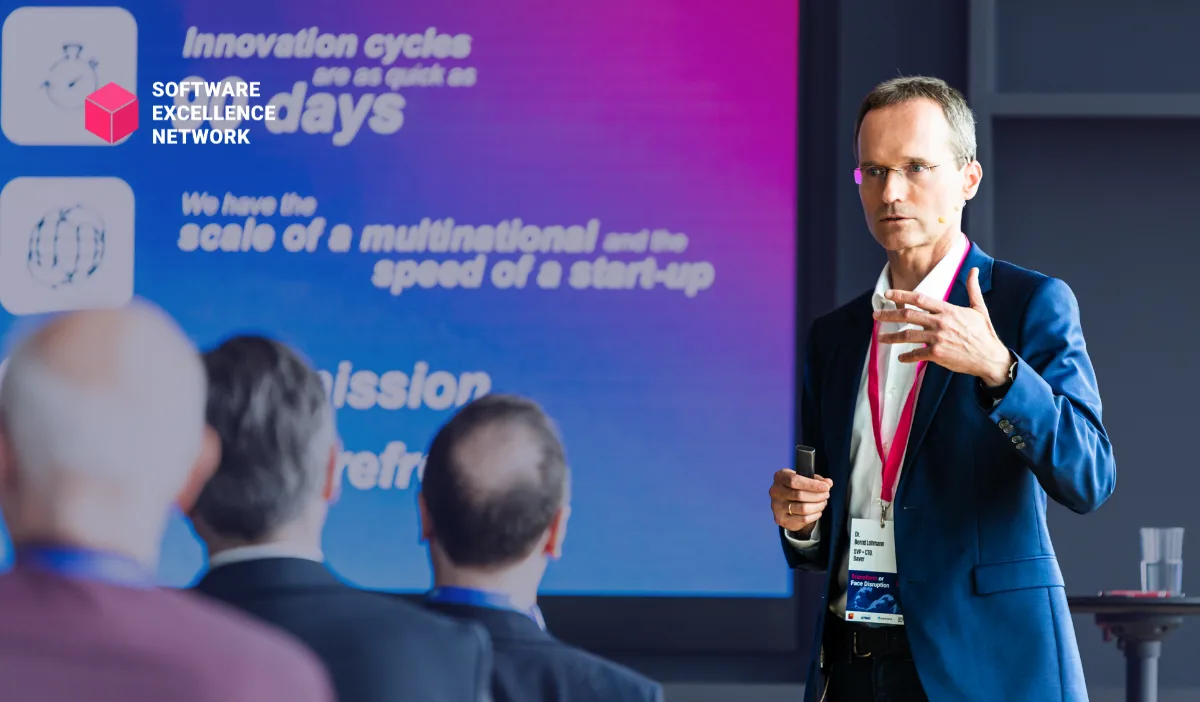
At the core of Dynamic Shared Ownership is a radical principle: push 95% of all decisions to the teams doing the work. No more steerco approvals. No more deferring to middle managers. Instead, small, autonomous squads are formed around customer outcomes and empowered to deliver end-to-end.
"People used to work for their bosses. Now, they work for the mission: Health for all, Hunger for none."
Managers don't approve work—they coach. Teams aren't functional units—they're cross-functional squads responsible for both delivery and decision-making. Everyone operates on equal footing, with fluid access to resources and clear accountability for value creation.
Enterprise Agility at Scale
The model is executed through 90-day outcome cycles. Each squad defines what it will deliver in the next quarter, executes with sprints (often weekly), and then retrospects, adjusts, and re-plans.
This shift away from static annual planning toward rolling agility has had far-reaching effects:
- Planning cycles are faster and more adaptive
- Budgets flow more dynamically to where value is created
- Strategic priorities are continuously realigned with real-world performance
- Employees feel greater ownership, motivation, and clarity of purpose
IT as a Product Organization
This transformation is particularly visible in Bayer's IT landscape through two case studies from Crop Science:
Next-Gen R&D Application for Trait Development
A once-siloed, multi-partner, ticket-heavy legacy system is now maintained by a dedicated product squad. It includes a product owner, developers, data scientists, and IT architects—all in one team with full-stack responsibility.
"They own the application, the data pipelines, and the infrastructure. No more handoffs."
Modernized Order Entry Portal
Built within Bayer's SAP environment, a legacy portal for seed orders is now undergoing weekly iterative development by a unified team of business and IT experts. The result is a projected 90% reduction in development costs, faster delivery, and better alignment with customer needs.
From Projects to Products—and Beyond
CIOs are no strangers to the productization of IT. But Bayer takes it a step further by aligning even infrastructure and data operations to product teams—as long as the product is in active evolution.
Once software products reach a stable state, they are transitioned to shared service maintenance—a blended model of internal employees and offshore partners. This helps ensure long-term sustainability without sacrificing agility or efficiency.
AI and Data Strategy Implications
Perhaps the most overlooked challenge of decentralization is data fragmentation. Silos remain a reality—even under the new model. But Bayer is investing heavily in data asset management and shared semantics to reduce overlap and ensure interoperability across divisions.
"Patient data, for example, used to be split between research and commercial. Now, unified data assets support both."
This investment is not just about analytics—it's about preparing for the AI-native enterprise, where consistent, well-governed data flows are essential for enabling machine learning, generative AI, and digital twin technologies.
The Future of the CIO: Architect of Culture and Capability
What does all this mean for CIOs?
- Agile-at-scale isn't a framework—it's a cultural reprogramming
- IT must operate like a product company—with business inside the team
- Hierarchy is an innovation killer—distributed ownership drives outcomes
- Data architecture is the foundation for AI scale
- Leadership is about empowerment, not control
Bayer's Dynamic Shared Ownership model is a glimpse into the post-digital enterprise: agile, federated, purpose-driven, and AI-ready. It's not without resistance or risk, but the early results—reduced headcount without productivity loss, faster cycles, higher engagement—are promising.
Purpose as a Platform
When CIOs ask how to attract talent, empower teams, and compete in an AI-driven market, one key insight emerges: start with purpose.
Whether engineering seeds, fighting cancer, or writing code—the organizational mission isn't just a slogan. It's an operating system for transformation.